Three GSC checks to confirm a March 2026 core hit
Google ran three algorithm events in Q1 2026 leaving indie dev sites uncertain. This issue gives you a 10-minute GSC diagnostic — penalty gate, date alignment, impressions-vs-clicks pattern — to confirm whether you were hit, then covers the one practitioner-proven recovery action: content pruning targeting a 20–30% reduction in indexed pages.
If your organic traffic dropped in the past six weeks and you're not sure why, there's a good chance one of Google's Q1 2026 algorithm events is the culprit — or a good chance it isn't, and you're about to waste months fixing the wrong thing.
Google ran three separate ranking events between late January and early April 2026. An unconfirmed quality update around January 20 drove 70–90% traffic losses for AI content farms and self-promotional affiliate sites 1. The March 2026 Spam Update completed in under 20 hours on March 24–25 2. Then the March 2026 Core Update rolled out March 27 through April 8 — Google's first broad core update of the year — and affected an estimated 55%+ of monitored sites globally 3. Unconfirmed volatility waves continued into May 8 and May 13–14 4.
That's a lot of possible causes. Before you start rewriting content or noindexing pages, spend 10 minutes in Google Search Console (GSC) running three checks. They'll tell you whether you have an algorithmic hit, a manual penalty, a SERP layout issue, or nothing at all.
Step 0: Rule out a manual penalty first
This takes under a minute and must come first. In GSC, go to Security & Manual Actions → Manual Actions. If it says "No issues detected," you don't have a penalty — you have an algorithmic change, which means a reconsideration request won't help and you should proceed to the three checks below.
If you see a violation listed (unnatural links, thin content, cloaking), you have a manual penalty, not an algorithmic ranking drop. The recovery path is completely different: fix the violation, then submit a reconsideration request 5.
Also: don't make major structural changes to your site while a Core Update is still rolling out. Rankings shift throughout the rollout window. For the March 2026 Core Update (completed April 8), the safe analysis window only opened in mid-to-late April 5.
Image credit: Google Core Update vs Spam Update: What's the Difference and How to Recover (Digital 4 Africa)
The three checks
Check 1: Date alignment
Open status.search.google.com/products/rGHU1u87FJnkP6W2GwMi/history — Google's official ranking update history. Note the exact date your GSC impressions or clicks started declining, then look for any confirmed update whose start date falls within ±3 days of your drop onset 6.
Key confirmed windows to check for Q1–Q2 2026:
- February 5–27: Discover Core Update (affects Discover feed only, not web search)
- March 24–25: Spam Update (under 20 hours — sudden overnight disappearances)
- March 27 – April 8: Core Update (gradual decline over 1–3 weeks)
If your drop falls outside all confirmed windows, a core update is unlikely the cause. Check Google Trends for the same date range — if search demand for your top queries dropped globally, you're dealing with a demand issue, not a ranking issue 7.
Date alignment is a gate, not a confirmation. Passing it means Google was active when your traffic dropped — it doesn't yet say whether your site was affected.
Check 2: Impressions vs. clicks pattern
In GSC → Performance → Search Results, set a date comparison: 30 days before vs. 30 days after your drop date. Enable both Impressions and Clicks.
Look at impressions before clicks. The characteristic core update signal is impressions declining across 20 or more pages simultaneously during a confirmed update window — that pattern indicates a site-wide algorithmic reassessment, not a page-level issue 6.
Then go to the Pages tab and sort by "Clicks Difference" (largest decline first). Look for one of three patterns 8.
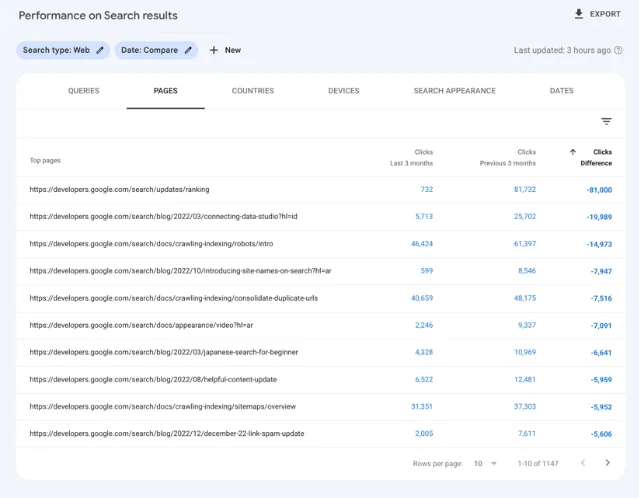
Image credit: Debug Google Search Traffic Drops (Google for Developers)
| Pattern | What it likely means |
|---|---|
| 20+ pages across different topics all declined | Core Update: Google re-assessed your site holistically |
| Pages in one topic cluster all declined together | Google re-weighted signals for that specific topic area |
| Only 2–3 pages declined | Not a core update pattern — check for a stronger competitor or a SERP layout change |
| Clicks dropped but impressions held steady | CTR problem, not ranking — AI Overviews or SERP features are capturing clicks before users reach your result |
One sorting note: a page that lost 60% of its impressions is a stronger signal than a large page that lost 5% 6. Sort by percentage change on your smaller pages, not just absolute numbers.
Check 3: Semrush Sensor cross-reference
Go to sensor.semrush.com (free, no account needed). Look at the volatility score for the same dates your traffic dropped. If the Sensor was ≥8 out of 10 during your drop window, the SERP disruption was industry-wide — which supports an algorithmic cause rather than a site-specific problem. If the Sensor was calm (below 5) and only your site moved, you're looking at a site-specific issue 6.
If all three checks confirm a core update hit
The recovery action with the most real-world evidence from Q1-Q2 2026: content pruning and consolidation, not content improvement.
The core move is to categorize every indexed page into four buckets — Keep & Optimize, Consolidate (merge into a stronger page), Delete (noindex genuinely thin content), Redirect (301 to a relevant page) — and reduce your indexed page count by 20–30% 9. Googlebot recrawling after the pruning can produce measurable improvement in 4–6 weeks.
One B2B SaaS site reported on r/SEO recovered roughly 70% of traffic lost in the December 2025 Core Update within 3 months by consolidating pages — and the merged pages ranked higher than the originals ever did 10.
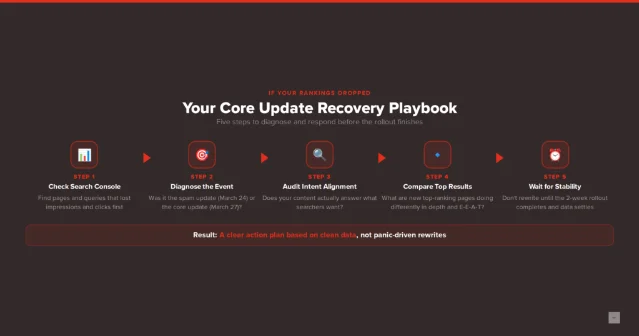
Image credit: Google March 2026 Core Update: What You Need to Know Right Now (The HOTH)
- Updating publish dates or adding a few sentences — Google recognizes cosmetic freshness signals without quality change
- Publishing more content to compensate — sites with 5,000+ pages often see crawl budget wasted on thin content, which makes indexing worse
- Link disavow campaigns — Google's John Mueller has said core update drops are rarely about links 5
Set the right recovery timeline: 3–6 months for meaningful recovery, not 3–6 weeks 9. Core update recovery is validated at the next core update — changes you make in May may not fully register until the next broad update cycle.
The 10-minute sequence: Manual Actions check (1 min) → date alignment on the Status Dashboard (3 min) → Impressions vs. Clicks comparison in GSC Performance (4 min) → Semrush Sensor spot check (2 min). At the end, you'll know whether you're dealing with a core update hit, a spam action, a SERP layout shift, or a demand drop — and each has a different fix.
Cover image credit: Did a Google Core Update Hit Your Site? (Search Engine Hub)
References
- 1Mobidea Academy: Diagnose and Recover From the Q1 2026 Google Quality Update
- 2Google Search Status Dashboard: March 2026 spam update
- 3Google Search Status Dashboard: March 2026 core update
- 4SERoundtable: Google Search Ranking Volatility Heated May 13th & 14th
- 5StyleFactory Productions: How to Recover from a Google Core Update (2026)
- 6Search Engine Hub: Did a Google Core Update Hit Your Site?
- 7Google for Developers: Debug Google Search Traffic Drops
- 8ClickRank: Google March 2026 Core Update: What Changed & What To Do
- 9DigitalApplied: Surviving the March 2026 Core Update: Recovery Guide
- 10r/SEO: Big traffic drop after Dec 11, 2025 Google core update
- 11Mobidea Academy: Why More Content Hurts Rankings (And How to Fix It in 2026)
Add more perspectives or context around this content.